
Shop Vacs
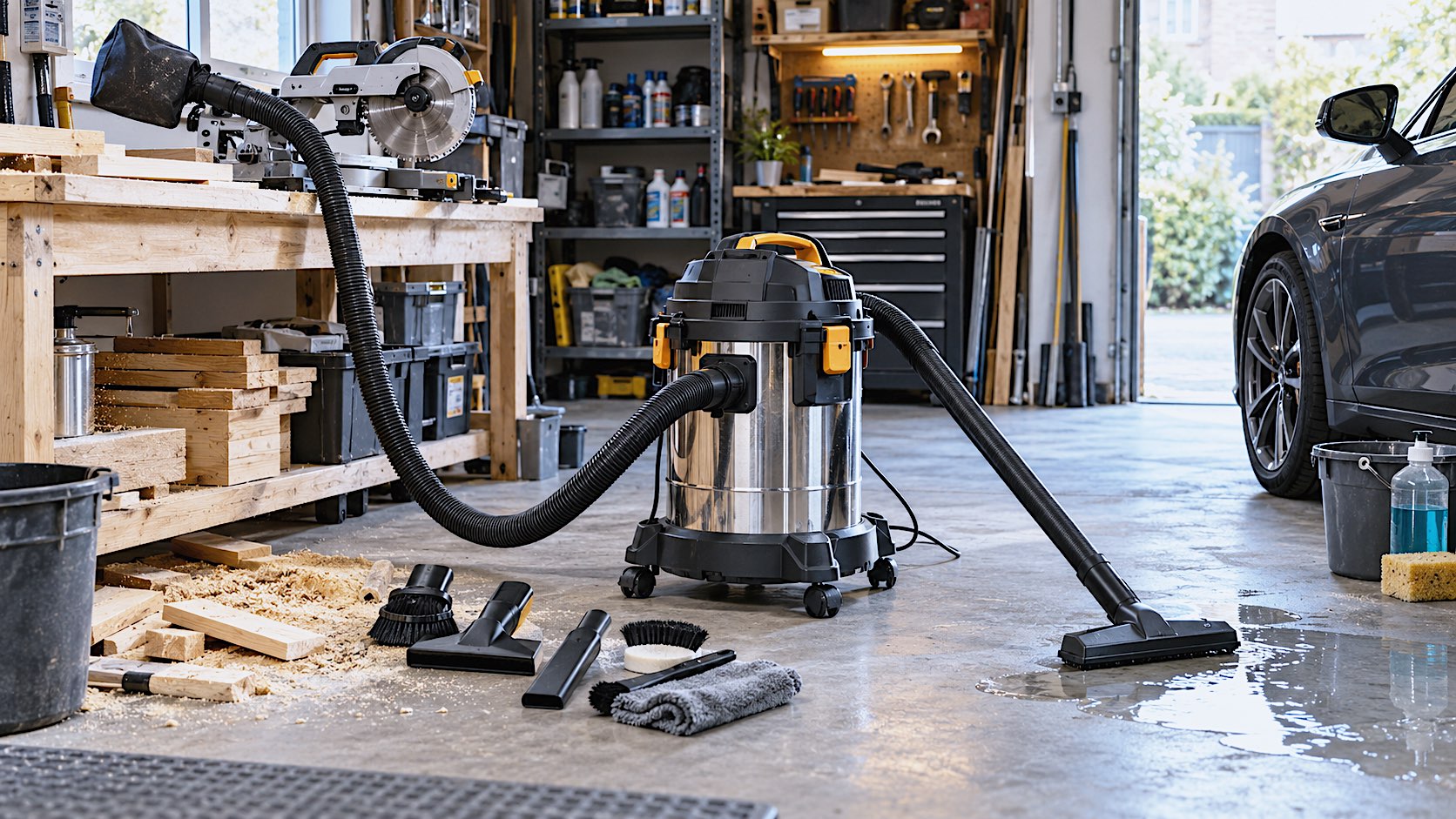
A shop vac looks simple: a large canister, a powerful motor and a hose capable of swallowing the sort of mess you would never put through an ordinary household vacuum. That simplicity is part of the appeal.
For garages, DIY, car cleaning, renovation debris and accidental spills, a good shop vac can be one of the most useful cleaning tools you own. But there is an important catch: A shop vac is not automatically a safe dust extractor. That distinction matters once you start dealing with fine wood dust, plaster, concrete, silica or other hazardous materials.
If you’re at the beginning of the buying process, start with the material you want to collect rather than tank size or motor wattage.
|
What you want to clean |
Good place to start |
|---|---|
|
Garage floors, leaves, general dirt |
Standard wet/dry shop vac |
|
Car interiors |
Compact shop vac with useful detailing tools |
|
Water spills |
Wet/dry vacuum specifically rated for liquid pickup |
|
DIY rubble and larger debris |
Larger wet/dry shop vac |
|
Sawdust and chips from occasional DIY |
Shop vac with suitable filtration and tool connection |
|
Regular woodworking dust |
Proper M-class or suitable higher-class extractor |
|
Fine construction dust |
Appropriate M- or H-class extraction depending on the task |
|
Cold fireplace debris |
Appropriate ash vacuum — not an ordinary shop vac |
|
Hot ash |
Neither: allow it to become completely cold first |
|
Flammable liquids or combustible/explosive dust |
Specialist equipment only |
The best shop vac is therefore not simply the one with the biggest motor. It’s the one designed for the material, volume and risk involved.
What is a shop vac?
“Shop vac” is commonly used as shorthand for the canister-style heavy-duty vacuums used in workshops, garages and DIY environments.
In the UK you are more likely to see retailers describe them as:
- wet and dry vacuum cleaners
- workshop vacuums
- industrial vacuums
- dust extractors
- wet/dry extractors
Those terms overlap, but they do not always mean the same thing.
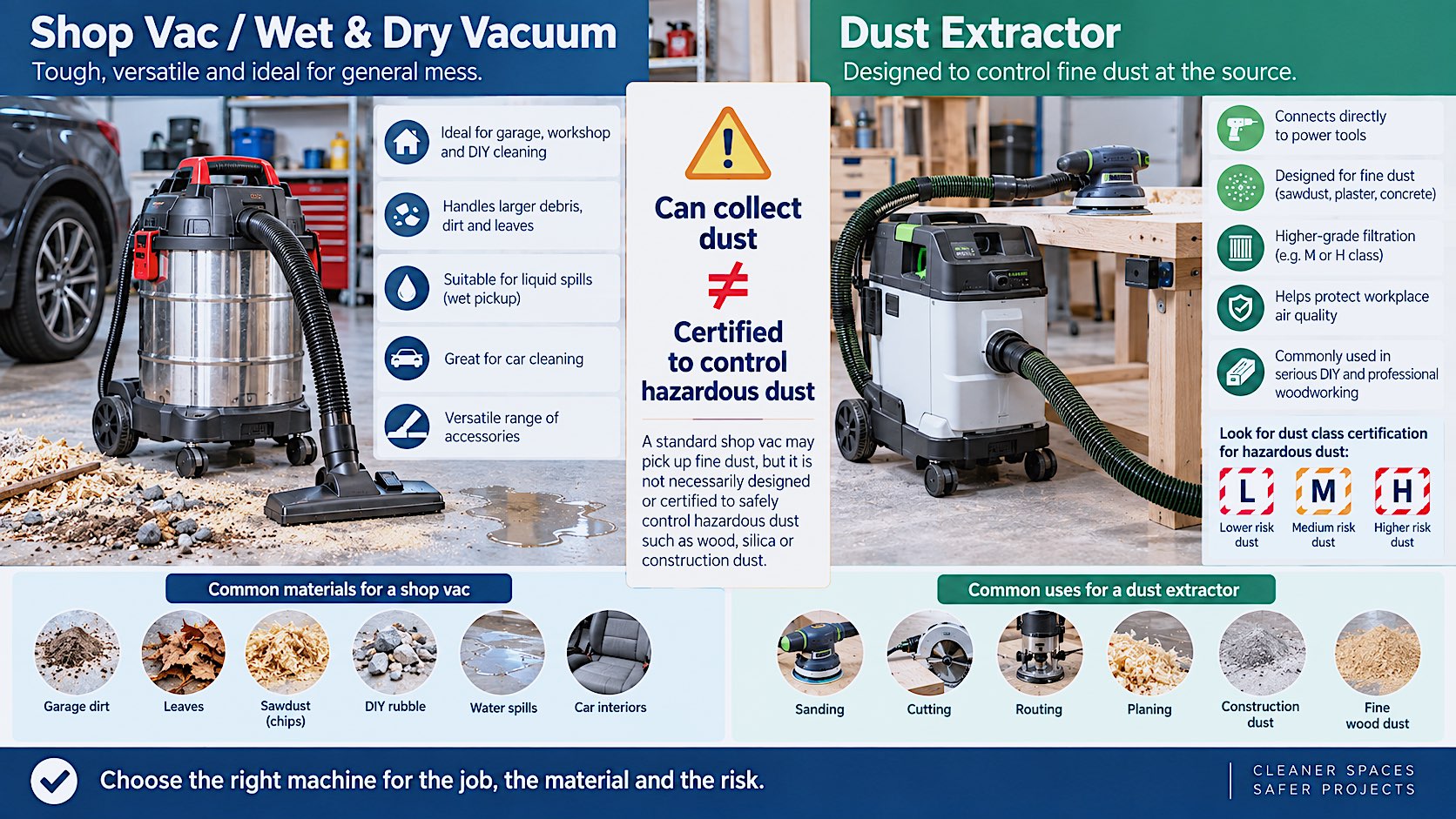
A conventional shop vac is typically designed to handle larger and messier debris than a domestic vacuum, often with a tough plastic or stainless-steel container and the ability to collect liquids. A dust extractor, by contrast, may be designed around controlling fine airborne dust generated by a power tool. That difference becomes important very quickly.
Shop vac vs wet/dry vacuum vs dust extractor
These terms are frequently treated as interchangeable online when they should not be.
Shop vac / wet-and-dry vacuum
Usually designed for:
- general debris
- garage cleaning
- DIY mess
- liquid spills
- car interiors
- larger particles
Its strengths are versatility and toughness.
Dust extractor
Usually designed to connect directly to tools such as:
- sanders
- track saws
- routers
- circular saws
- mitre saws
Its job is not merely to clean the floor afterwards. It is to capture dust close to where it is being produced.
Professional machines may also carry a certified dust class.
Industrial vacuum
This is a much broader category.
Industrial vacuums can be designed for anything from ordinary factory debris to hazardous, combustible or highly specialised materials.
Do not assume that a machine described as “industrial” is automatically suitable for hazardous dust.
The distinction that matters most
A shop vac may collect fine dust. That does not necessarily mean it is suitable for collecting that dust safely.
The Health and Safety Executive says woodworking clean-up should use industrial vacuum equipment meeting at least Class M and specifically advises against dry sweeping or compressed-air cleaning of wood dust. For construction clean-up involving fine material, HSE guidance similarly refers to M- or H-class extraction/vacuum equipment.
That’s why simply adding a fine filter or seeing the letters “HEPA” on a consumer shop vac doesn’t automatically turn it into a certified hazardous-dust extractor.
What actually makes a good shop vac?
For ordinary household vacuums, floorhead design has an enormous influence on cleaning ability. With a shop vac, the priorities shift.
You should pay attention to:
- airflow
- suction pressure
- hose diameter
- filtration
- tank capacity
- filter-cleaning system
- tool compatibility
- wet-pickup design
- durability
And, again, motor wattage alone tells you surprisingly little.
Suction pressure and airflow are different things
Vacuum specifications can become confusing because manufacturers may quote:
- watts
- air watts
- litres per second
- litres per minute
- cubic feet per minute (CFM)
- millibars
- kilopascals (kPa)
You do not need to become an engineer to buy one.
The useful distinction is:
Suction pressure describes how strongly the machine can pull against resistance.
Airflow describes how much air it can move.
A machine dealing with larger chips and debris benefits from moving plenty of air, while stronger vacuum pressure becomes useful through restricted hoses, tools and nozzles.
A well-designed machine balances both.
Motor wattage
Wattage tells you about electrical input, not the cleaning performance of the complete machine.
Hose design, seals, filter condition and airflow path all influence what actually reaches the nozzle.
So avoid comparisons such as:
1,400 W must be better than 1,000 W.
It may be. It may not.
Tank capacity: bigger isn’t automatically better
Shop vac tanks can become surprisingly large.
More capacity means:
- fewer stops to empty
- more room for bulky debris
- greater liquid capacity
But it also means:
- a bigger machine
- more storage space
- more weight
- potentially a very heavy container when filled with water
Remember that one litre of water weighs roughly one kilogram.
A large wet/dry vacuum containing twenty or thirty litres of liquid can therefore become awkward very quickly.
If the machine will mostly clean the car, workbench and occasional DIY mess, buying an enormous tank may make it worse to live with.
Hose diameter matters more than many buyers realise
A large hose is useful for:
- wood chips
- leaves
- rubble
- screws
- larger debris
A narrower hose can be:
- easier to manoeuvre
- more suitable for handheld power tools
- better for detailed car cleaning
The other question is compatibility.
Power-tool dust ports are notoriously inconsistent.
If tool extraction is part of your plan, investigate:
- hose diameter
- supplied reducers
- tool adapters
- aftermarket connectors
- whether the hose fits your existing tools
Do this before buying rather than discovering afterwards that the hose and sander refuse to speak to each other.
Wet pickup: one of the main reasons to own a shop vac
A proper wet/dry vacuum can deal with messes that should never go through a standard dry household vacuum.
Examples include:
- leaking appliance water
- garage puddles
- small plumbing spills
- water in a vehicle footwell
- workshop spills involving appropriate non-hazardous liquids
Electrical Safety First specifically warns against vacuuming wet floors with equipment that is not designed for wet use.
But check the setup first
Wet/dry machines differ.
Depending on the model, wet operation may require you to:
- remove a paper or fleece dust bag
- change the filter
- use a particular filter
- leave the cartridge filter installed
- fit a foam filter
There is no universal rule. Follow the manual for your machine.
Most also incorporate a float mechanism that restricts or stops airflow once the liquid level becomes too high.
If the motor suddenly changes pitch during liquid pickup, stop and check whether the tank is full.
Bags are more useful in shop vacs than they first appear
A bagless metal or plastic tank looks like part of the whole shop-vac appeal.
For chunky garage debris, that can be perfect.
Fine dry material is different.
A suitable disposable bag can:
- make emptying cleaner
- protect the main filter
- reduce filter clogging
- make fine debris easier to contain
For workshop use, fleece bags can be particularly useful.
The downside is the ongoing consumable cost.
And unless your particular machine explicitly says otherwise, do not leave a conventional dry dust bag installed while vacuuming liquids.
Filters: the part people neglect until suction disappears
A shop vac can have an impressive motor and still perform terribly with a blocked filter.
Fine dust rapidly loads filters.
As resistance increases:
airflow falls → pickup gets worse → the motor works harder → cleaning becomes frustrating.
Better machines may therefore provide:
- manual filter cleaning
- semi-automatic filter cleaning
- automatic filter cleaning
These systems are particularly valuable if the machine is regularly connected to sanding or cutting tools.
For occasional garage debris, they matter much less.
What do L, M and H dust classes mean?
This is where shop-vac buying becomes a safety question rather than simply a cleaning question.
Professional dust extractors may be classified as:
- L — lower-risk dust
- M — medium-risk dust
- H — higher-risk dust
Machines designed for these applications are tested as systems rather than simply having a fine filter added to an ordinary vacuum. Nilfisk describes the L, M and H classifications under the relevant European hazardous-dust standards, with progressively higher containment requirements.
For the typical UK DIYer, the important practical point is simpler:
Wood dust
HSE states that industrial vacuum equipment used for cleaning wood dust should meet at least Class M.
For cutting and sanding wood, HSE recommends on-tool extraction using an M- or H-class extraction unit, alongside suitable respiratory protection where required.
Construction dust
Concrete, bricks, mortar and many other building materials can produce extremely fine hazardous dust.
Respirable crystalline silica is particularly serious; HSE describes exposure as a cause of silicosis, COPD and lung cancer.
For finer construction debris, HSE guidance calls for M- or H-class vacuum/extraction equipment rather than simply sweeping it around.
The buying lesson
If your use case is:
“Clean the garage, car and occasional DIY mess”
a normal wet/dry shop vac may be ideal.
If it is:
“Connect this to my sander every day and collect MDF dust”
you have moved into proper dust-extractor territory.
HEPA filtration does not automatically mean M-class
HEPA describes filtration performance.
M-class describes the requirements for a hazardous-dust extraction machine.
They are not interchangeable labels.
A consumer vacuum may legitimately contain a highly efficient filter without having the containment, monitoring, disposal system or machine certification associated with a professional M-class extractor.
For ordinary cleaning, high-efficiency filtration can still be valuable.
For controlled hazardous-dust work, buy the correctly rated machine for the task.
Shop vacs and power tools
One of the best uses of a workshop vacuum is capturing debris before it spreads everywhere.
Look for a machine with a power-tool take-off socket if this is important to you.
The idea is simple:
- plug the vacuum into the mains
- plug the tool into the vacuum’s socket
- connect the extraction hose
- switch the vacuum into automatic mode
- start the tool
- the vacuum starts automatically
- when the tool stops, the vacuum usually runs briefly before stopping
That final overrun helps clear the hose.
This is considerably nicer than manually switching two machines on and off every time you make a cut.
Check the socket’s load rating
Do not assume you can connect any high-powered tool.
The vacuum should specify the maximum permitted load for the power-tool socket.
Follow it.
Antistatic hoses: not just another premium accessory
Moving dry dust through plastic hoses can generate static electricity.
At the mild end, that can mean unpleasant little shocks.
More demanding professional environments may require properly conductive or antistatic systems as part of the overall extraction setup.
HSE specifically notes that hoses used for wood-dust on-tool extraction should be suitable for the material, including antistatic requirements.
For occasional household use it may not be a decisive feature.
For regular tool extraction, it is worth considering.
Corded or cordless shop vac?
Cordless wet/dry vacs are increasingly useful, particularly where mobility matters.
Cordless makes sense for
- car cleaning
- quick garage jobs
- vans
- small spills
- sites without convenient sockets
- users already invested in a battery platform
Corded makes more sense for
- lengthy workshop sessions
- power-tool extraction
- repeated wet pickup
- larger jobs
- maximum continuous runtime
Battery ecosystem matters considerably here.
If you already own several tools using the same batteries, a compatible shop vac can make much more sense than beginning another charger-and-battery collection.
The attachments that are genuinely useful
Shop vacs often arrive with a box of plastic tubing that initially looks interchangeable.
It isn’t.
Floor nozzle
Useful for:
- garage floors
- workshop floors
- larger areas
Some have separate wet and dry inserts.
Crevice nozzle
Excellent for:
- vehicle interiors
- workbench edges
- machinery
- between seats
Brush
Useful on:
- dashboards
- shelving
- delicate surfaces
Wide car nozzle
A worthwhile addition if vehicle cleaning is important.
Power-tool adapter
Potentially one of the most valuable accessories in the box.
Check that it actually fits your tools.
Blower mode: useful, but use some judgement
Some shop vacs allow the hose to connect to the exhaust and turn the vacuum into a blower.
This is useful for things such as:
- removing leaves from an appropriate area
- clearing coarse debris
- drying certain surfaces
It is a terrible way to clean hazardous fine dust.
HSE repeatedly advises against using compressed air or dry methods that simply redistribute fine wood or construction dust into the air.
If the material is dangerous to breathe, your goal is to capture it, not launch it across the workshop.
What you should never put through an ordinary shop vac
A tough-looking stainless-steel tank does not make a vacuum indestructible.
Do not assume an ordinary shop vac is suitable for:
Specialist applications require specialist equipment.
Some combustible-dust environments, for example, require specifically certified equipment rather than an ordinary workshop vacuum. Nilfisk’s specialist ranges illustrate how different such machines are from general wet/dry cleaners, including grounded systems and specific certifications for hazardous or combustible dust.
What about fireplace ash?
Do not assume “it’s just dust”.
Fine ash can:
- pass through unsuitable filtration
- damage ordinary filters
- contaminate the exhaust
- conceal hot material for surprisingly long periods
Dedicated ash vacuums are designed around this application. Even then, follow the manufacturer’s requirements regarding temperature and permitted material. Never vacuum hot or glowing ash.
How big a shop vac do you actually need?
Think about the mess rather than the size of your shed.
Compact machine
Best for:
Medium machine
The useful middle ground for many homeowners:
Large machine
Makes sense for:
But remember the downside: You eventually have to move and empty it. A giant tank is not an advantage if you hate carrying it.
Features worth paying for
Particularly useful
- good filtration
- easy filter access
- wet/dry capability
- sensible hose length
- suitable hose diameter
- secure accessories
- drain outlet on larger tanks
- power-tool socket
- automatic tool start
- replaceable hoses and filters
- easy-to-source bags
- stable castors
- long power cable
Worth paying extra for if you use power tools frequently
- automatic filter cleaning
- M-class certification where required
- antistatic hose
- variable suction
- tool adapters
- automatic power-tool control
Nice rather than essential
- stainless-steel tank
- remote controls
- extensive accessory storage
- elaborate displays
A shiny metal drum may look more industrial, but it does not automatically provide better suction, filtration or durability.
Seven shop-vac buying mistakes
1. Buying on motor wattage alone
It does not tell you airflow at the nozzle or filtration performance.
2. Assuming “wet/dry” means anything can go through it
It does not.
3. Buying a huge tank for occasional car cleaning
You will spend years tripping over it.
4. Ignoring replacement filters and bags
Check the price and availability before buying the machine.
5. Assuming HEPA means certified hazardous-dust extraction
It doesn’t.
6. Buying for power-tool extraction without checking connections
A fantastic vacuum with the wrong adapter is still annoying.
7. Treating a consumer shop vac as personal protective equipment
Extraction can form part of dust control, but appropriate PPE/RPE and working methods may still be necessary for hazardous tasks. HSE explicitly notes that respiratory protection may be needed alongside extraction for woodworking and construction tasks.
How to get better performance from a shop vac
Empty it before it is packed solid
A completely full container leaves less room for airflow and debris separation.
Keep the filter clear
If pickup deteriorates after collecting fine dust, check the filter before assuming the motor is failing.
Use a bag for fine dry debris when appropriate
It can dramatically reduce mess inside the machine and protect the main filter.
Use the largest sensible hose for coarse debris
Large chips clog small hoses more easily.
Reduce the hose size near tools when necessary
Smaller tool ports often need appropriate adapters.
Avoid unnecessary hose length
Long hoses increase resistance.
Use enough to work comfortably without creating an enormous coiled airflow path for no reason.
Shop-vac maintenance
These machines tolerate abuse, but they perform much better when they receive basic care.
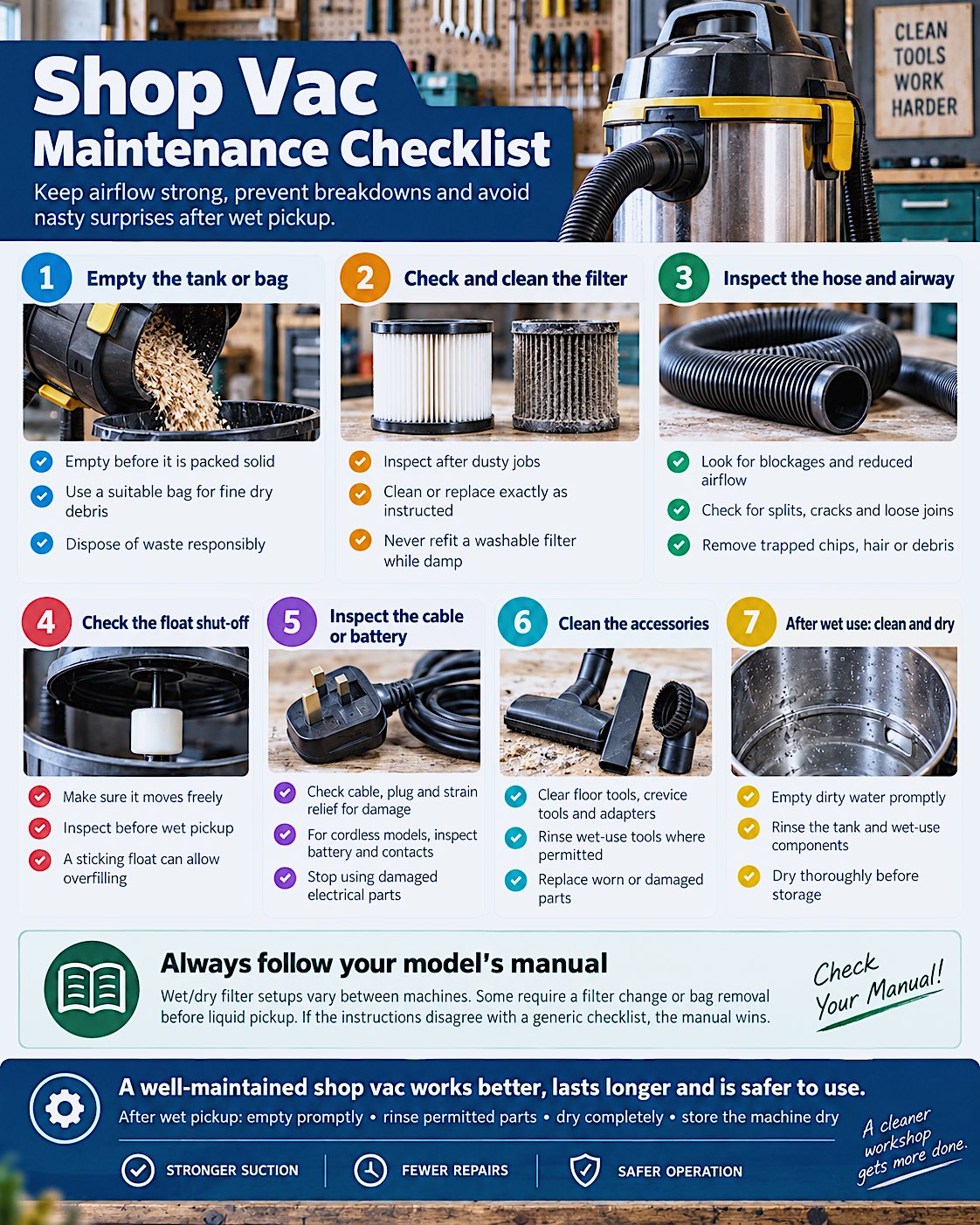
After dry use
- empty the container
- inspect the bag if fitted
- check the filter
- inspect the hose for obstructions
- remove tangled material from tools
- check seals and clips
After wet use
Do not leave dirty water sitting inside the machine.
- unplug it
- empty the tank
- rinse appropriate components
- clean wet accessories
- allow everything to dry properly
- inspect the float mechanism
- store the machine dry
Otherwise that wet tank soon becomes its own biological experiment.
Check the electrical side
Regularly inspect:
- power cable
- plug
- extension lead
- battery
- charger
Electrical Safety First recommends checking plugs and cables for damage, stopping use if there are signs such as burning smells or unusual noises, and using the correct batteries and chargers for cordless equipment.
When working outdoors or in other situations where electrical risk is increased, suitable RCD protection is sensible and may already be provided by the electrical installation.