
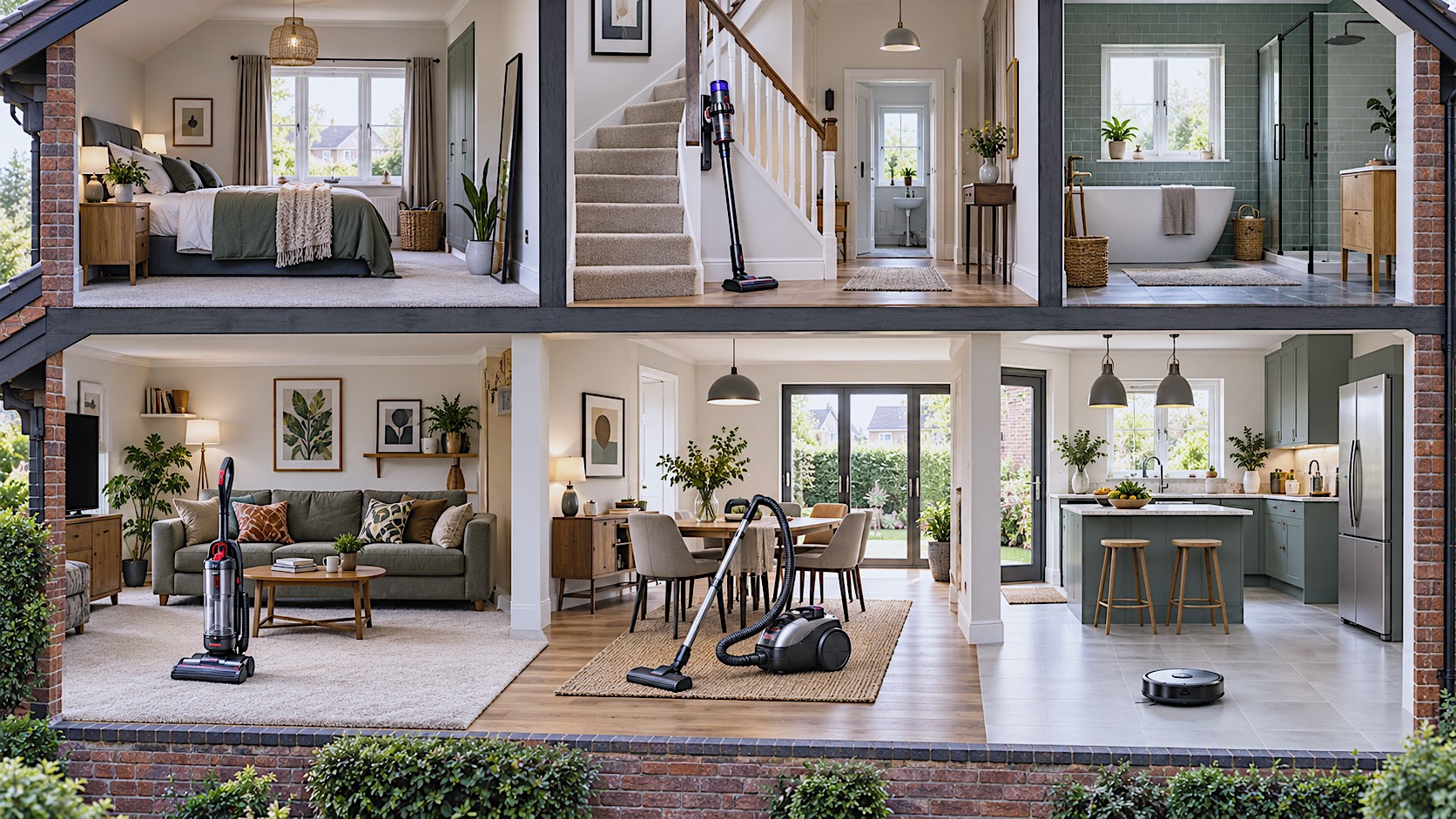
Domestic Vacuum Cleaners
Buying a vacuum cleaner gets confusing surprisingly quickly. Upright or cylinder? Corded or cordless? Bagged or bagless? Do you need HEPA filtration? Is 600 watts weak? Will a robot replace a normal vacuum? And is a £500 machine actually going to clean better than one costing £150?
If you are at the start of the buying process, do not begin with brands or specifications. Begin with your home.
The right domestic vacuum cleaner is the one that suits your floors, the size and layout of your home, the mess you actually create and the amount of maintenance you’re prepared to do.
For most households, the first decision looks something like this:
|
Your home or cleaning style |
Good place to start |
|---|---|
|
Lots of carpet |
Upright or powerful cylinder vacuum with an effective brush head |
|
Mostly hard flooring |
Cylinder or cordless stick with a suitable hard-floor head |
|
Small flat |
Cordless stick |
|
Large house |
Corded upright/cylinder, or a cordless with genuinely useful runtime and replaceable battery |
|
Several floors or lots of stairs |
Lightweight cordless or compact cylinder |
|
Pets |
Powered brush roll, anti-tangle design and upholstery/pet tool |
|
Dust allergy concerns |
High-filtration, well-sealed vacuum; consider bagged |
|
Daily crumbs and light debris |
Cordless stick or robot |
|
Garage, renovation debris or liquid spills |
Proper wet-and-dry vacuum |
|
You hate vacuuming |
Robot for routine maintenance, plus a conventional vacuum for deeper cleaning |
That is a much better starting point than choosing whichever machine claims the highest suction figure.
What actually makes a vacuum cleaner good?
A domestic vacuum cleaner needs to do four things well:
- Lift dirt from the surface
- Move that dirt through the machine
- Keep it inside the machine
- Remain practical enough that you actually use it
That last point matters more than it sounds.
A wonderfully powerful 8 kg upright stored beneath the stairs is not necessarily a better purchase than a lighter machine you will happily grab three times a week.
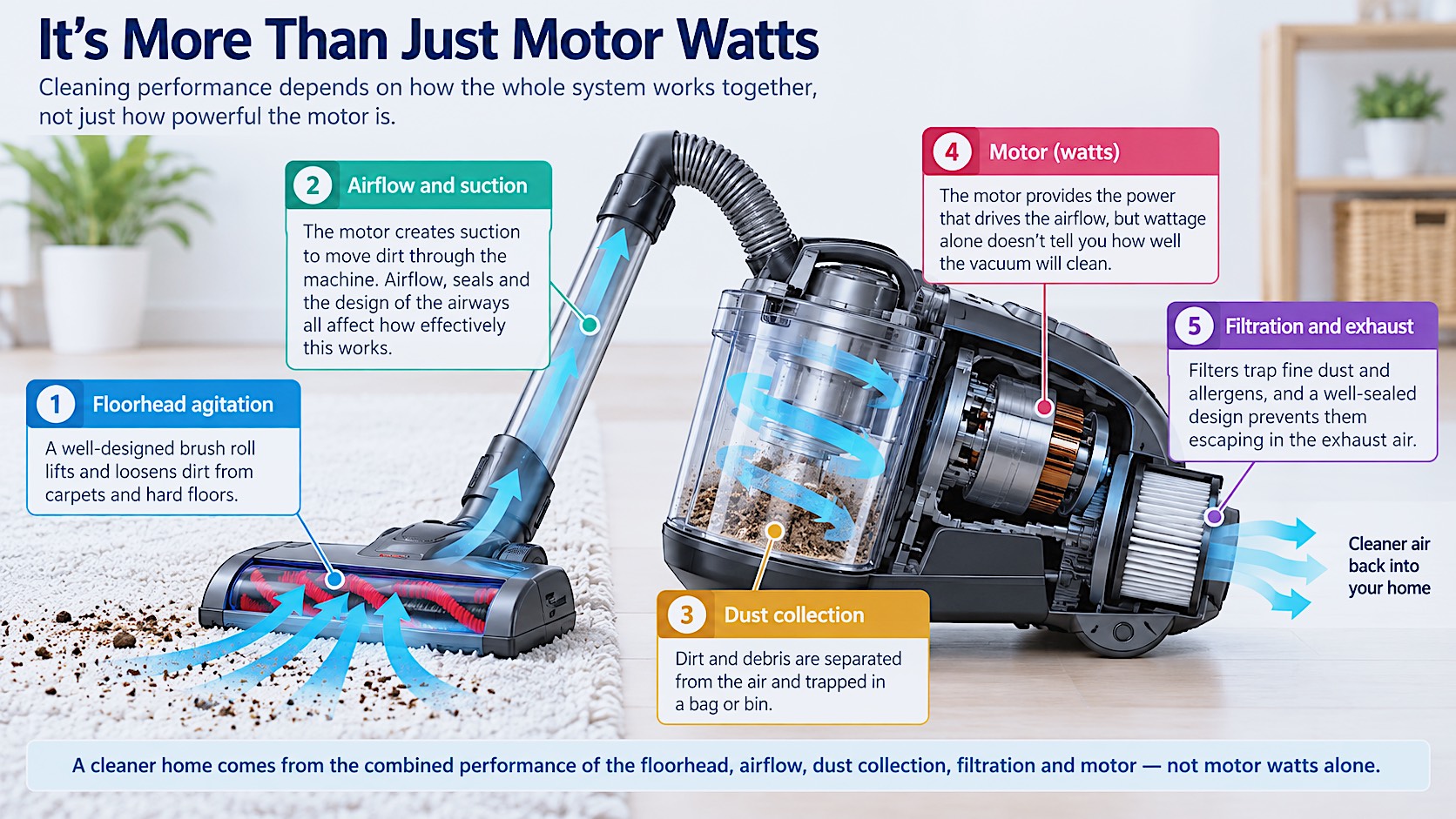
Suction matters, but wattage doesn’t tell the whole story
Motor wattage primarily tells you how much electrical power the motor consumes. It does not directly tell you how much dust the vacuum will remove from your carpet.
Cleaning performance also depends on:
- airflow
- suction pressure
- floorhead design
- how well the floorhead seals against the surface
- brush-roll design
- filtration
- internal airways
- how well performance is maintained as the bin or bag fills
Modern machines can clean very effectively with lower-powered motors than older vacuums. Miele, for example, specifically attributes cleaning performance to the combination of motor efficiency, airflow and floorhead design rather than simply chasing a larger wattage figure.
Independent testing reinforces the point. Which? assesses actual dust, debris and pet-hair pickup, filtration and whether suction deteriorates as the vacuum fills rather than judging cleaners on headline motor figures.
Practical rule: compare measured cleaning performance where independent testing is available, rather than selecting a vacuum because one specification has a bigger number.
The main types of domestic vacuum cleaner
Upright vacuum cleaners
An upright vacuum cleaner combines the motor, dust container and main cleaning head into one unit that you push across the floor.

They remain particularly useful in carpet-heavy homes because the main floorhead can incorporate a substantial powered brush roll.
Best for
Advantages
Drawbacks
A detachable hose or lift-away body can make an upright considerably more useful around stairs and furniture.
Cylinder vacuum cleaners
A cylinder vacuum keeps the motor and bag or bin in a wheeled body, connected to the cleaning head by a hose and wand.
You may also see these described online as canister vacuums, particularly on American websites.
Best for
Cylinder machines can feel lighter in the hand than uprights because you are mainly moving the wand and floorhead, although the main body still has to follow you around.
One thing worth checking in person is how well the body follows behind you. Some glide beautifully; others repeatedly catch on doorframes and furniture.
Cordless stick vacuum cleaners
Cordless stick vacs have become the default choice for people prioritising convenience.
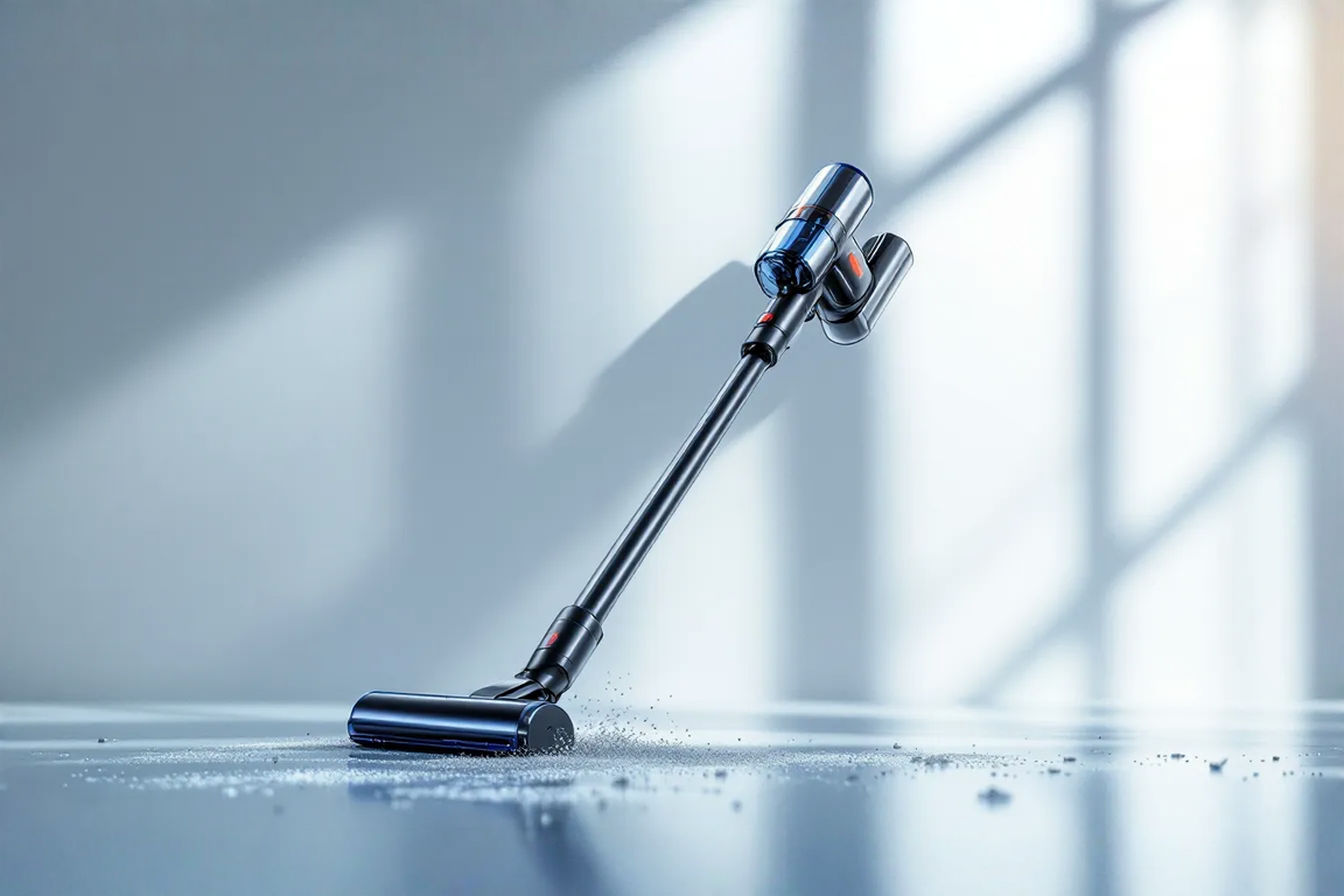
Their appeal is obvious: take one off the charger, clean the kitchen, stairs or entire downstairs and put it back without finding a socket or dragging a cable around.
The best cordless machines are now capable of replacing a corded vacuum in some homes, but that does not mean every cordless vacuum is good enough to do so. Which? continues to find large performance differences between models, particularly on carpet, while also highlighting smaller dust capacities and limited runtime as disadvantages of the format.
Best for
Advantages
Drawbacks
The specification people misunderstand: runtime
A claim such as “up to 60 minutes” may apply only in the lowest-power mode and possibly without a motorised floorhead.
Carpet cleaning on boost mode can produce a dramatically shorter figure.
When comparing cordless machines, look for:
- normal-mode runtime
- powered-head runtime
- maximum-power runtime
- recharge time
- removable battery
- price of a replacement battery
A swappable battery is particularly useful in a larger house.
Robot vacuum cleaners
Robot vacuums are best understood as maintenance cleaners, not miniature replacements for every conventional vacuum.
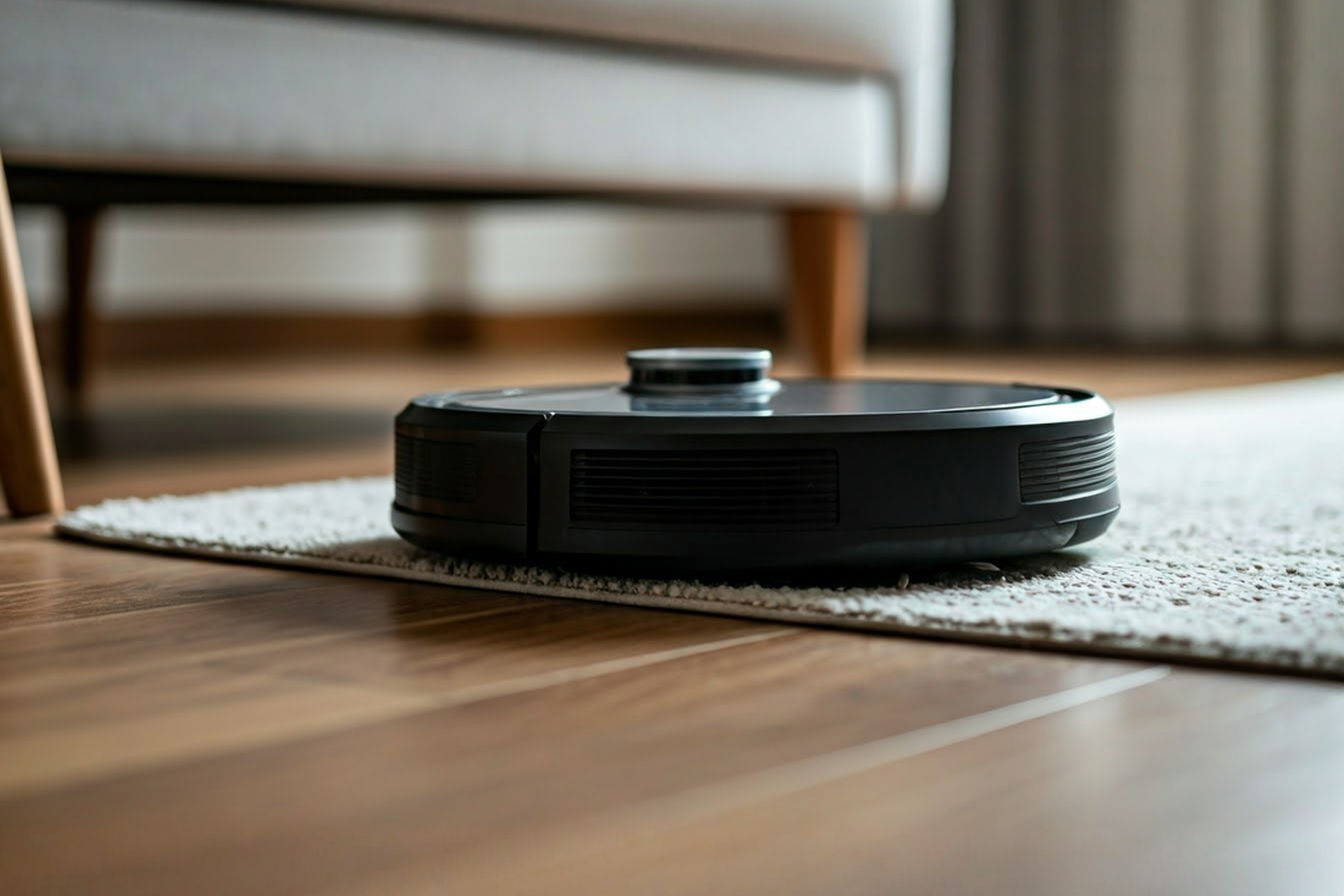
They can be excellent at keeping everyday dust, crumbs and pet hair under control because they clean more frequently than most people would manually.
Best for
Less suitable for
More expensive robots may offer mapping, room selection, obstacle detection, automatic emptying and mop functions.
The useful question is not whether a robot has an impressive app. It is whether your home is physically suitable for a robot to move around reliably.
For many households, robot + conventional vacuum makes more sense than trying to make the robot do everything.
Handheld vacuum cleaners
A handheld is a convenience appliance for:
It normally should not be your only vacuum.
Which? testing similarly finds handhelds useful for quick jobs but generally unsuitable for replacing a full-sized vacuum for deeper household cleaning.
Wet-and-dry vacuum cleaners
A genuine wet-and-dry vacuum is designed to collect both dry debris and liquids.
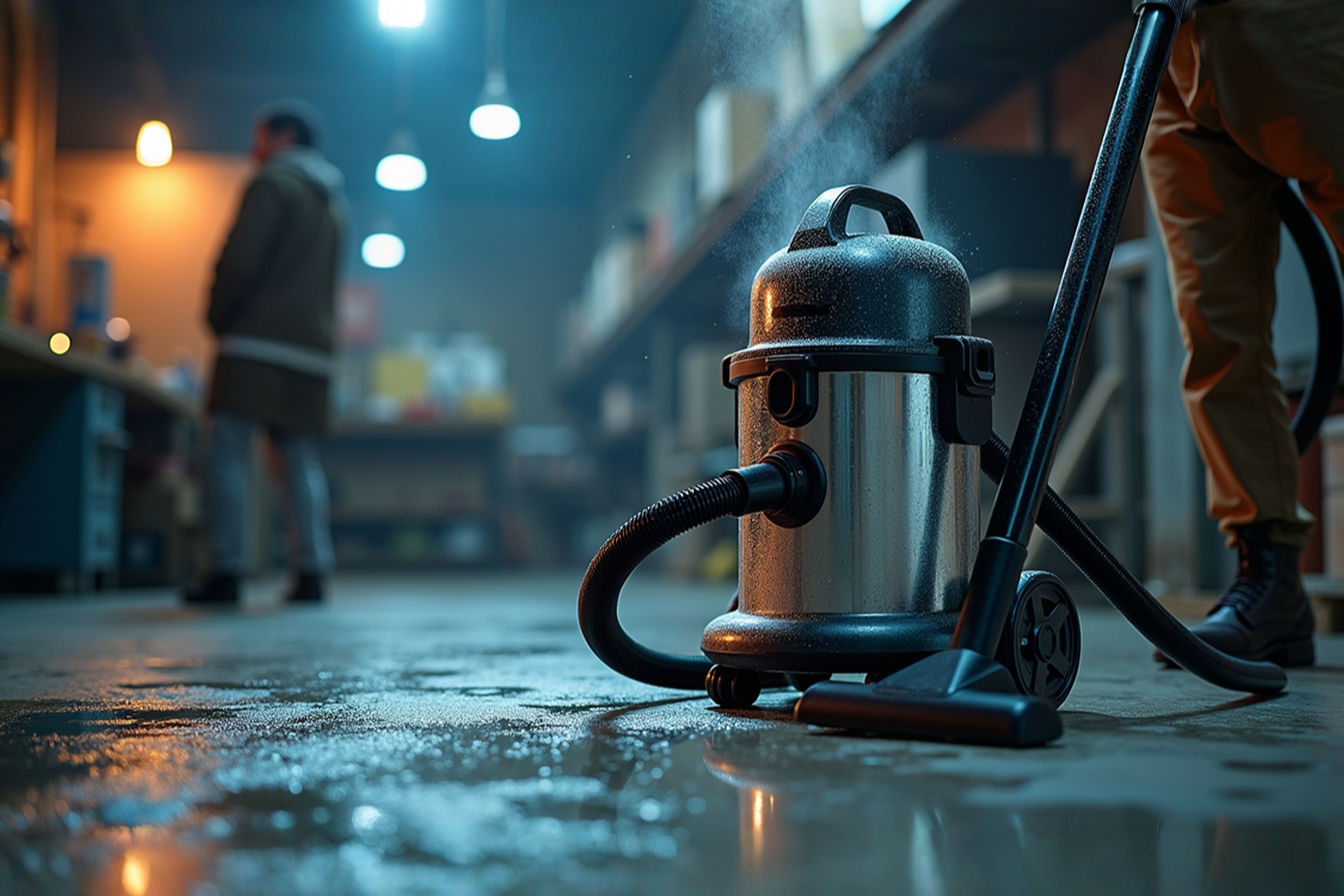
This makes one useful for:
They tend to sacrifice refinement for durability and capacity.
Some are loud, bulky and unpleasant to use as an everyday living-room vacuum.
Also distinguish a wet-and-dry vacuum from a vacuum mop or floor washer. The latter is usually intended to wash hard flooring with clean and dirty water tanks rather than act as a general-purpose vacuum for carpets, sofas and stairs.
Corded or cordless?
This is probably the biggest decision for many buyers.
Choose corded if you value:
- unlimited cleaning time
- consistently available full power
- larger capacity
- lower purchase price for comparable cleaning performance
- whole-house carpet cleaning
Choose cordless if you value:
- convenience
- lower carrying weight
- stair cleaning
- fast daily cleaning
- compact storage
- car cleaning
There is no rule saying a modern home must choose one or the other.
A very practical setup for a larger household is:
corded machine for proper weekly cleaning + small cordless for daily mess.
Equally, a good cordless cleaner can be perfectly adequate as the sole vacuum in a smaller home.
Bagged or bagless?
This choice affects maintenance almost as much as cleaning.
|
Bagged |
Bagless |
|
|---|---|---|
|
Emptying |
Remove and dispose of sealed bag |
Empty reusable bin |
|
Dust exposure |
Usually lower |
Potential dust cloud when emptied |
|
Running cost |
Replacement bags |
Usually no bags |
|
Often less frequent |
Often more frequent |
|
|
Capacity |
Often larger |
Often smaller |
|
Convenience |
Bag must be available |
Empty whenever required |
|
Waste |
Disposable bag |
Less consumable waste |
Bagged vacuums
A good bag acts as part of the filtration system and can make disposal pleasantly clean: remove the bag, close it and throw it away.
That makes bagged machines particularly attractive where dust exposure is a concern.
The downside is obvious: you have to keep buying the correct bags.
Before buying, check:
- price of genuine or compatible bags
- availability
- how many come in a pack
Bagless vacuums
Bagless designs remove that ongoing consumable but expose you more directly to the collected dirt.
This matters for allergy sufferers. Allergy UK advises care when emptying bagless machines because doing so can release dust and allergens back into the air.
Emptying outside directly into a refuse bag can help.
Filtration: when HEPA really matters
Filtration deserves attention if anyone in the household is particularly sensitive to dust, pollen or animal allergens.
The useful question is not simply:
“Does it say HEPA?”
You also want the machine to keep dirty air from leaking around the filter through gaps in the casing.
Allergy UK recommends efficient pickup and filtration that prevents allergens escaping from the exhaust.
So look for:
- proper high-efficiency filtration
- a well-sealed air path
- good independent allergen-retention results
- hygienic bag or bin emptying
If allergies are a major consideration, a well-sealed bagged machine with high-grade filtration is often worth investigating.
The floorhead can matter more than another fancy feature
The part actually touching your floor deserves close attention.
For carpet
A rotating brush can agitate the pile and release embedded hair and dirt.
Look for:
- powered brush roll
- adjustable power or floor setting
- easy brush access
- anti-tangle system if your household has long hair or pets
Very high suction is not automatically better. A badly matched vacuum can clamp itself to thick carpet and become exhausting to push.
For hard floors
You want effective pickup without scratching.
Useful features include:
- dedicated hard-floor head
- soft roller
- brush-roll shut-off
- suction adjustment
Check the manufacturer’s guidance for delicate timber, laminate or specialist flooring.
For rugs
Light rugs can get sucked into powerful floorheads.
Adjustable suction or a controllable brush roll can make an enormous difference.
Pet owners should look beyond the word “Pet”
Manufacturers frequently create a “Pet” edition by supplying different accessories.
That can be useful, but check what you are actually receiving.
The most valuable features tend to be:
- effective main brush roll
- resistance to hair wrapping around the roller
- motorised mini upholstery tool
- easy brush-roll access
- strong filtration
- sufficiently large bin or bag
The small powered tool can be particularly useful for sofas, stairs, mattresses and fabric car seats.
Capacity is boring until you buy one that’s too small
A tiny bin can be perfectly reasonable in a small flat.
Put the same machine into a large house with two shedding dogs and you could be emptying it several times during one clean.
Cordless cleaners usually trade capacity for portability. Which? reports substantially smaller average capacities for cordless machines than conventional corded ones.
Consider the whole cleaning cycle:
vacuum → empty → clean filter → recharge
A vacuum that saves two minutes while cleaning but adds five minutes of maintenance may not actually be the convenient option.
Features worth paying attention to
Useful
Nice to have
Usually less important than the marketing suggests
Spend money on cleaning ability, usability and maintainability first.
How much should you spend?
There is no magic price at which vacuum cleaners suddenly become good.
The market has strong inexpensive machines as well as expensive poor performers. Competent corded options can be found around the £100 level, while good cordless cleaners commonly sit considerably higher and many tested models fall in roughly the £200–£400 area.
As a rough shopping framework rather than a price guarantee:
|
Budget |
What to expect |
|---|---|
|
Under £100 |
Basic corded cleaners, handhelds and budget cordless models; choose carefully |
|
£100–£250 |
Strong territory for conventional corded vacuums and some capable cordless models |
|
£250–£500 |
Premium cylinders/uprights and many high-spec cordless machines |
|
£500+ |
Premium cordless systems, sophisticated robots and convenience features |
Higher price increasingly buys convenience, engineering, batteries, accessories, automation and finish, not necessarily proportionally cleaner floors.
Prices move constantly, so compare current models rather than treating these bands as fixed.
What to check before buying
Make a five-minute inventory of your home before opening retailer tabs.
Floors
How much is:
- carpet?
- hard flooring?
- rugs?
- deep pile?
Layout
Count:
- floors
- stairs
- awkward corners
- low furniture
- rooms without convenient sockets
Mess
Do you deal with:
- long hair?
- pet hair?
- cat litter?
- children’s crumbs?
- muddy entrances?
- DIY debris?
Storage
Where will the vacuum actually live?
For cordless machines, ask:
- is there a socket there?
- can you wall-mount a dock?
- will it charge without becoming a trip hazard?
Physical usability
Try to assess:
- weight
- balance
- handle comfort
- steering
- trigger placement
- how heavy it feels when cleaning above floor level
- how easily you can carry it upstairs
A specification sheet cannot tell you whether your wrist will hate a top-heavy cordless vacuum after ten minutes.
Seven things I would avoid
1. Buying purely on motor watts
They do not tell you how well the entire machine cleans.
2. Judging cordless machines by maximum runtime
Find out what happens with the normal powered floorhead attached.
3. Buying a tiny bin for a large pet-owning home
You will rapidly resent it.
4. Assuming every HEPA-labelled vacuum contains dust equally well
Filtration and machine sealing both matter.
5. Buying a mystery cordless model without checking batteries and spares
The battery may be the first major component you eventually need.
6. Paying heavily for smart features before checking basic pickup performance
A screen cannot compensate for a bad floorhead.
7. Using one vacuum for jobs it was never designed to do
A normal domestic dry vacuum is not a workshop extractor, ash vacuum or wet vacuum.
How to vacuum more effectively
Even a good machine performs badly when used badly.
Use the appropriate setting
Maximum power is not always necessary.
For cordless cleaners, lower settings conserve battery; higher settings are more useful for demanding carpet or heavily soiled areas. Which? recommends matching power level to surface and cleaning requirement rather than simply running maximum mode everywhere.
Slow down
Give the floorhead time to lift dirt.
One deliberate forward-and-back pass is often more useful than racing repeatedly across the same area.
Deal with the room first
Before vacuuming:
- pick up cables
- move tiny objects
- check for coins or screws
- shake out mats if appropriate
- move lightweight obstacles
This protects the machine as well as improving coverage.
Use the attachments
The crevice tool is not packaging filler.
Use it for:
- skirting edges
- sofa seams
- radiator gaps
- corners
- car seats
Use an upholstery or powered mini tool for fabric and pet hair.
Work from cleaner areas towards dirtier ones
And after dusting shelves or furniture, vacuum the floor so dislodged dust is removed rather than left behind.
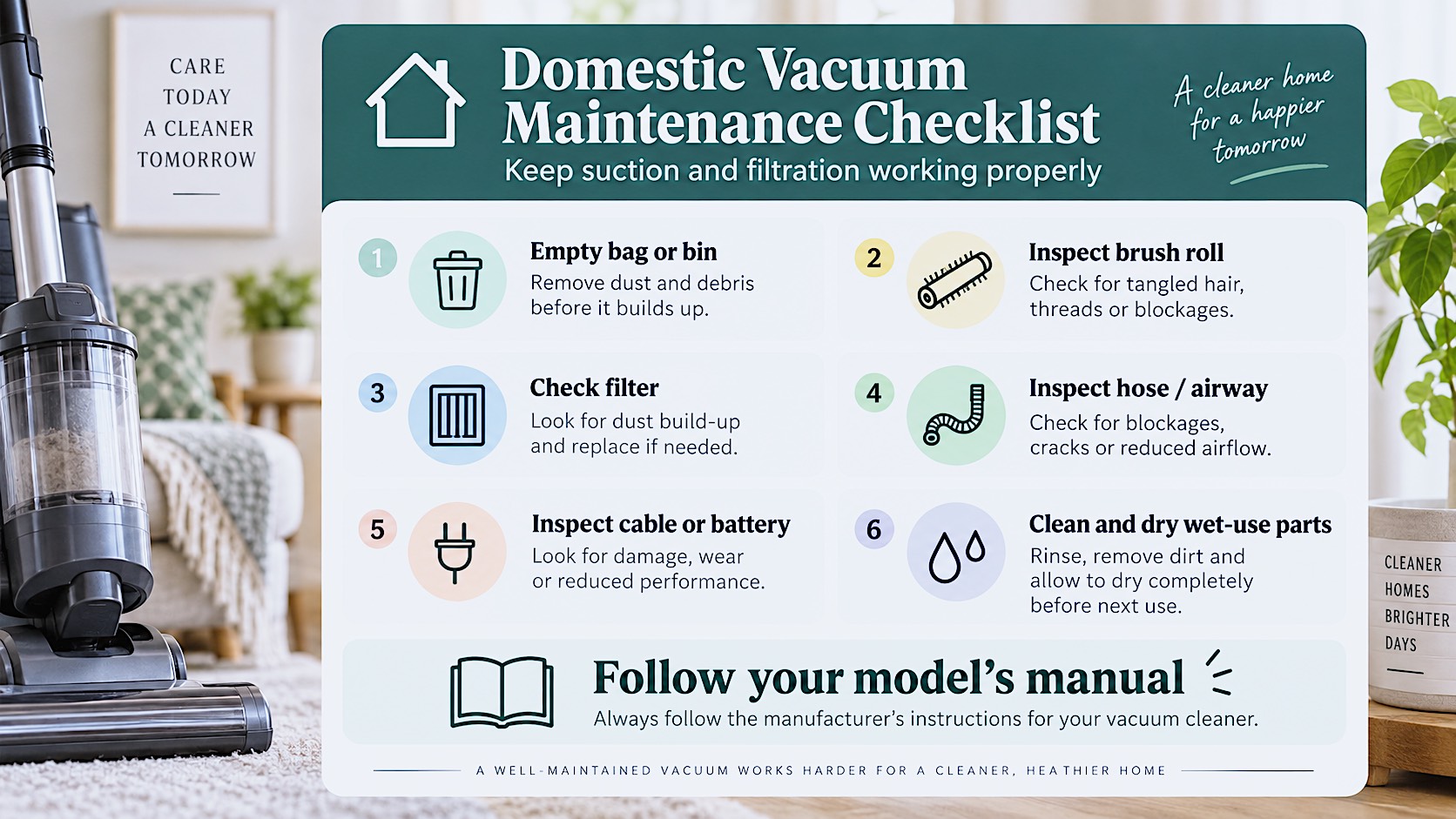
Vacuum cleaner maintenance: the basics that prevent most problems
Loss of suction often has a mundane cause: full collection container, blocked airway, dirty filter or hair wrapped around the brush roll.
Empty the bin or change the bag
Do not deliberately run it packed solid.
Follow the fill indicator or manufacturer’s recommended level.
Check the brush roll
Hair and thread can gradually form a dense sleeve around it.
Some modern designs reduce tangling, but none should be assumed to be maintenance-free.
Switch off and disconnect the machine before removing debris.
Keep filters clean
This does not mean washing every filter.
Some are washable. Some are not.
Check the manual.
If washing is permitted:
- remove the filter
- clean it as instructed
- allow it to dry completely
- only then reinstall it
Never put a damp filter back into a machine that requires it to be dry.
Check the airway
If suction suddenly collapses, inspect:
- floorhead
- wand
- hose
- inlet
- bin
- filters
A child’s toy, leaf or clump of hair can cripple an otherwise healthy vacuum.
Clean wet machines immediately after wet use
Dirty water rapidly begins to smell.
Empty, rinse and dry the parts specified by the manufacturer.
Things you should not vacuum
Unless your machine is specifically designed for the job, avoid:
Some domestic-vacuum manuals also specifically exclude materials such as plasterboard dust and fireplace ash.
Electrical Safety First advises against using ordinary vacuum cleaners on wet floors unless they are specifically designed for it and recommends checking cables, plugs, batteries and chargers for damage.
If the machine produces a burning smell, sparking, abnormal heat or unusual electrical noises, stop using it.
Cordless owners should also use batteries and chargers approved as suitable by the manufacturer rather than assuming any physically compatible replacement is safe.
So what kind of vacuum cleaner should you start looking at?
If you are still at the research stage, narrow the market rather than trying to choose a model immediately.
The best next step is to write down your floor types, home size, stairs, pets, storage space and preferred cleaning style. With those six things established, most of the vacuum-cleaner market can be eliminated before you even start comparing individual products.
That’s when shopping becomes much easier.