The Paracetamol Puzzle: How Does a Tiny Pill Find Your Pain?
Ever wondered how a paracetamol tablet knows you have a headache and not a sore toe? Explore the fascinating biological journey of Britain’s go-to medicine.
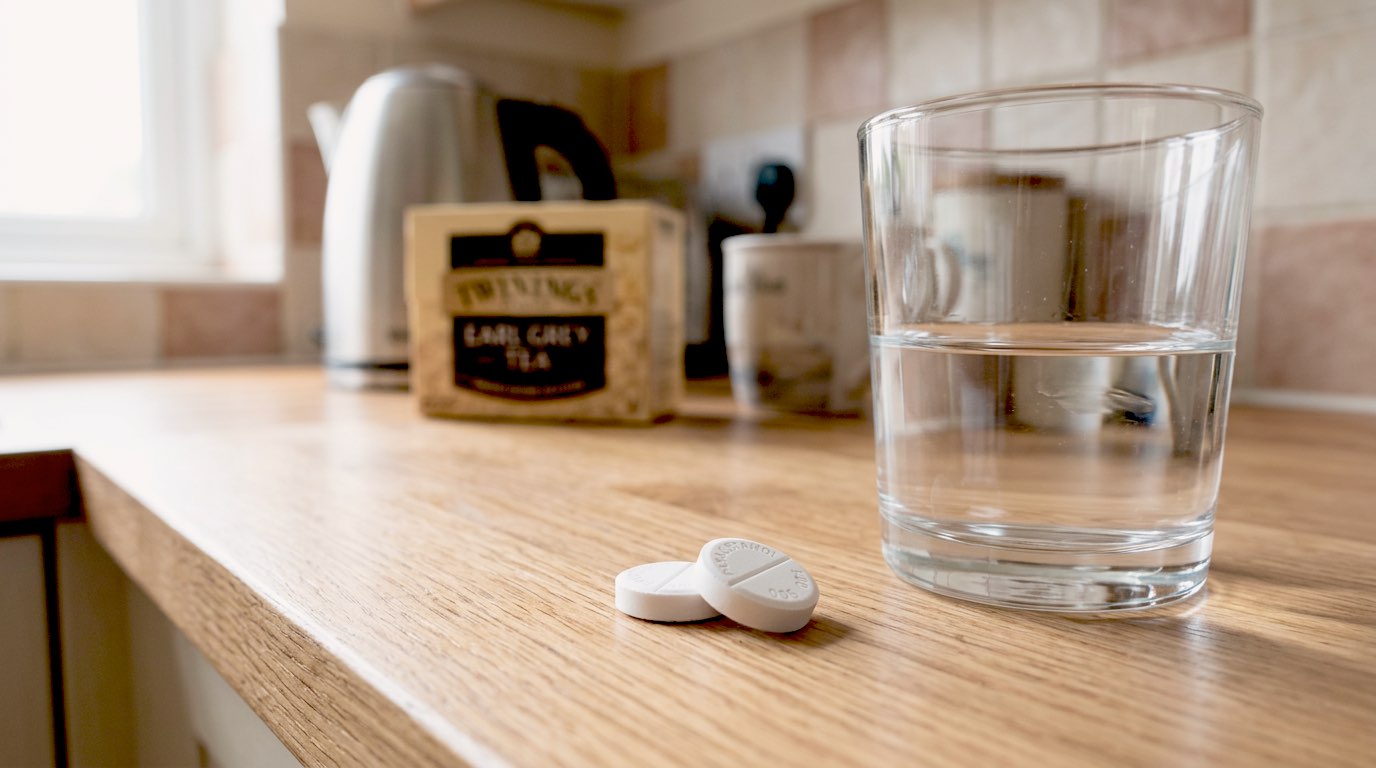
It is roughly 11:00 AM on a Tuesday, and you are currently experiencing what feels like a rhythmic percussion ensemble inside your skull. Whether it is the result of a stressful morning meeting or simply the unpredictable British weather playing havoc with your sinuses, the solution is almost instinctive. You reach for the white blister pack in the kitchen drawer, swallow two tablets with a splash of water, and carry on. Within half an hour, the “thumping” recedes into a dull hum and then vanishes entirely. It feels like a targeted strike—as if the medicine had a GPS tracker set specifically for your temples. Yet, the tablet didn’t travel through your veins directly to your head; it went to your stomach.
This raises a question that has baffled school children and curious adults alike for decades: how does that little white pill actually know where the pain is?
The answer is both simpler and far more sophisticated than you might imagine. Paracetamol—or acetaminophen, as our cousins across the Atlantic call it—doesn’t actually “know” anything. It doesn’t have sensors, it doesn’t navigate, and it certainly doesn’t have a map of your nervous system. Instead, it relies on a widespread chemical dampening system that fundamentally changes how your brain perceives “bad news” from your body.
Please note: The content below may contain affiliate links. If you make a purchase through these links, we could earn a commission, at no additional cost to you.
Quick Answers About Paracetamol
Does paracetamol travel directly to the site of pain? No. Once swallowed, paracetamol is absorbed into your bloodstream via the digestive tract. It then circulates throughout your entire body. It doesn’t “seek out” a specific injury; rather, it interacts with chemical messengers everywhere, but you only notice the relief in the areas that were actually hurting.
How long does it take for paracetamol to start working? Generally, you will begin to feel the effects within 30 to 60 minutes. This delay occurs because the tablet must dissolve in the stomach, move into the small intestine, enter the bloodstream, and pass through the liver before reaching the central nervous system to dampen pain signals.
Why is paracetamol often called the ‘mysterious’ drug? Unlike ibuprofen or aspirin, which have very clear mechanical actions at the site of an injury, paracetamol’s primary mechanism happens mostly within the brain and spinal cord. Scientists spent nearly a century debating exactly how it worked, and even today, new nuances of its interaction are being discovered.
Can I take paracetamol on an empty stomach? Yes, paracetamol is generally gentle on the stomach lining, unlike NSAIDs like aspirin. In fact, taking it on an empty stomach can lead to slightly faster absorption because there is no food to slow down its passage into the small intestine, where most absorption happens.
Is paracetamol the same as ibuprofen? No. They belong to different drug classes. Ibuprofen is a Non-Steroidal Anti-Inflammatory Drug (NSAID) that reduces swelling and redness at the source. Paracetamol is an analgesic and antipyretic; it focuses on raising your pain threshold and lowering your body temperature without significantly affecting inflammation.
The Great Biological Broadcast: How Drugs Move Through the Body
To understand how paracetamol “finds” your pain, we first have to dispel the myth of the “magic bullet.” We often talk about medicine in military terms—targeting, attacking, and destroying. In reality, taking a pill is more like pouring a bottle of red dye into a swimming pool. The dye doesn’t “look” for the deep end; it simply spreads until the entire pool is slightly pink.
When you swallow a paracetamol tablet, it journeys down the oesophagus into the stomach. Here, it begins to break apart. However, the stomach is mostly a transit lounge. The real action happens in the small intestine. Its vast surface area, lined with millions of tiny projections called villi, absorbs the paracetamol molecules into the portal vein.
This vein leads directly to the liver—the body’s primary chemical processing plant. The liver “vets” the paracetamol, breaking some of it down into metabolites. The remaining active drug is then pumped by the heart to every single corner of your body. It goes to your toes, your fingertips, your liver, and, crucially, your brain. You feel the relief in your headache because the drug is everywhere, including the place that hurts.
Prostaglandins: The Chemical ‘Ouch’ Signal
To understand how paracetamol stops pain, we have to understand what pain is in the first place. When you stub your toe or suffer a tension headache, your body’s cells produce chemical messengers called prostaglandins.
Think of prostaglandins as the “alarm bells” of the human body. When tissue is damaged or under stress, an enzyme called Cyclooxygenase (COX) goes to work, churning out these prostaglandins. These chemicals then do two things:
- They sensitise your nerve endings, making them much more likely to send an “ouch” signal to the brain.
- They signal the brain to increase the body’s temperature, leading to a fever.
But here’s the interesting part: most painkillers, like aspirin or ibuprofen, work by blocking the COX enzymes right at the scene of the crime—in your stubbed toe or your swollen joint. They stop the alarm bells from ringing locally. Paracetamol, however, is a bit of a wallflower. It doesn’t like to get involved in the messy, “hot” environment of an inflamed injury. Instead, it prefers the “cool” environment of the Central Nervous System (CNS)—your brain and spinal cord.
The Invisible Shield: The Mechanism of Action
While researchers are still fine-tuning the exact “biochemical handshake,” the prevailing theory is that paracetamol acts primarily by inhibiting COX enzymes within the brain. By doing this, it reduces the production of prostaglandins in the very place where pain signals are processed.
Essentially, paracetamol doesn’t stop the “alarm” from being triggered at your toe; it just turns down the volume on the “speaker” in your brain.
The ‘COX-3’ Mystery and Serotonin Pathways
For a long time, scientists were puzzled because paracetamol didn’t behave like other COX inhibitors. This led to the hypothesis of a “COX-3” enzyme, a variant found specifically in the brain that paracetamol was uniquely suited to block. While the COX-3 theory is debated, we now know paracetamol also interacts with the endocannabinoid system(the body’s internal version of the chemicals found in cannabis) and serotonergic pathways. These are the systems that naturally modulate and dampen pain.
By boosting these internal “feel-good” or “dampening” signals, paracetamol raises your overall pain threshold. You might still have the physical stimulus of the injury, but your brain decides it isn’t important enough to bother you with.
Why Doesn’t it Work for Everything? The Inflammation Gap
If you’ve ever had a severely swollen ankle or a red, angry tooth infection, you might have noticed that paracetamol doesn’t seem to do much. In typical British fashion, the drug is polite but has its limits.
This is because paracetamol is a poor anti-inflammatory. In areas of high inflammation, there are often high levels of “peroxides” (oxidising agents). These peroxides actually prevent paracetamol from working on the COX enzymes. This is why for a sprained ankle, a doctor might suggest ibuprofen—which thrives in those high-peroxide, inflamed environments—whereas for a “clean” pain like a headache or a post-vaccination fever, paracetamol is the gold standard.
The History of a Household Hero: From Coal Tar to the Chemist’s Shelf
The story of paracetamol is a classic tale of accidental discovery and slow-burn success. It didn’t start in a high-tech lab, but rather in the soot-stained world of 19th-century chemistry.
In the 1880s, chemists were experimenting with derivatives of coal tar to find alternatives to quinine (which was used for fever). A compound called acetanilide was found to reduce fever, but it had a nasty habit of turning patients’ blood blue (a condition called methaemoglobinaemia).
In 1893, a German chemist named Joseph von Mering identified paracetamol as a byproduct of these experiments. However, he mistakenly believed it shared the blood-thinning and blue-blood risks of its predecessors. For over half a century, paracetamol sat on the shelf, ignored and unloved.
It wasn’t until 1948 that researchers in the United States, specifically Bernard Brodie and Julius Axelrod, realised that paracetamol was actually the “good” part of those earlier drugs—the part that killed pain without the toxic side effects. It finally hit the UK market in 1956 under the brand name Panadol, marketed as being “gentle on the stomach” compared to the then-dominant aspirin.
The Liver: A Crucial British Warning
While we think of paracetamol as the safest drug in the cupboard, it has a “dark side” that involves the liver. Because the liver is responsible for processing the drug, it encounters a specific toxic byproduct called NAPQI.
Under normal doses (the standard 1g or two 500mg tablets), the liver has plenty of a protective antioxidant called glutathione to neutralise the NAPQI instantly. It’s a perfectly balanced system. However, if someone takes too much paracetamol, the glutathione stores are depleted. The NAPQI then begins to attack the liver cells themselves.
In the UK, this led to a significant piece of legislation in 1998. You may have noticed that you can only buy 16 tablets of paracetamol in a supermarket, or 32 in a pharmacy. This “pack size restriction” is a uniquely British intervention that has been credited with significantly reducing the rates of accidental and intentional liver toxicity. It is a testament to the idea that even the most “innocent” medicines require respect and regulation.
Future Frontiers: Is There a ‘Super-Paracetamol’ on the Horizon?
As we move further into the 21st century, researchers are looking at how to make paracetamol even more effective. One area of interest is intravenous paracetamol, which is already used in NHS hospitals for post-operative pain. By bypassing the digestive system entirely, it provides almost instantaneous relief.
There is also ongoing research into combining paracetamol with other molecules to prevent the liver toxicity mentioned above. Imagine a pill that kills your headache but also provides the liver with the “antidote” at the same time. While not yet a commercial reality, these developments represent the next chapter in our 150-year relationship with this molecule.
A Cultural Constant: Paracetamol in the British Psyche
In the UK, paracetamol is more than just a drug; it is a cultural touchstone. It is the “tea and sympathy” of the medicinal world. We give it for teething babies, we take it for the “flu,” and we keep a half-empty pack in the glove box of the car.
It doesn’t “know” where your pain is, but it knows how to quiet the noise. It is a humble, hardworking molecule that has survived over a century of scrutiny to remain the most used medicine in the country. The next time you feel that percussion ensemble starting in your head, you can appreciate the complex, body-wide journey those two little tablets are about to take—just to tell your brain that everything is actually going to be alright.
Further Reading:
- NHS Guide to Paracetamol
- The Pharmaceutical Journal: A History of Paracetamol
- Science Museum: The Discovery of Modern Painkillers
Subscribe for more
Get the latest posts delivered monthly so you never miss an article. Sign up below: